FIELD NOTE PRESENTATIONS · CONTEXT ENGINEERING
How I explained the work behind Generate
At JigSpace we built tools for making interactive 3D presentations called Jigs. I worked on the frontend of an AI platform designed to generate a Jig from a user’s brief and reference material, such as a product manual. When it was my turn to demo it to our team, I brought a slide about The Lord of the Rings.
// How I work · How I communicate
What was I missing?
An investor demo was coming up. Leadership wanted to show how quickly someone could click Generate and get a useful Jig back. I understood the pressure to have that ready. Meanwhile, our backend engineers were working late and through weekends on parts of the platform that would barely show up on screen.
One of our most experienced backend engineers kept bringing up the questions investors might ask after that first click. I knew how closely he followed developments in AI, and I could hear the worry in his voice. I could explain what we planned to show investors. What I couldn’t explain yet was why he thought the work behind the demo mattered so much. I wanted to find out what I was missing.
Following one request through the code
I started with something I could trace myself: the request our frontend sent. I worked through the backend repositories with several AI coding agents, following that request to see what each service received and what it passed on. That left me with specific questions. Would the user’s brief and the kind of Jig they wanted give us enough to find the right passages? Or would we also need to know which part of the 3D model they were asking about?
I took those questions back to the engineers. One showed me an architecture diagram and pointed out the parts we weren’t doing yet. In another conversation, we discussed what an existing tool could do for us: it could read a PDF and split it into passages. That still left a decision for our product to make. Which of those passages belonged in this particular Jig?
I wrote back with a suggestion. Could we pick one PDF, mark the passages we’d expect to use, and point to the step in the finished Jig that should change because of them? That would give us one small example we could demonstrate and check.
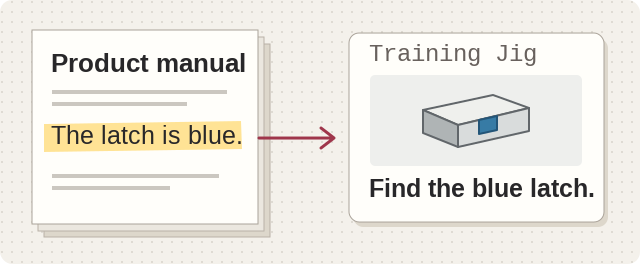
That was when my colleague’s concern clicked for me. A demo could work beautifully if we chose the passages ourselves. The harder problem was getting the platform to make that choice reliably for the next customer. I agreed with him that this was where much of the product’s value lay. When my turn came at our internal team meeting, I wanted to show why that work was worth doing.
Where I started with the rest of the team
I started where anyone in the room could follow me. I described a Jig in one sentence, chose a use case and clicked Generate. Once everyone had seen the result, I took them back through that click. Where had the details in this Jig come from, when I’d typed so little?
For the slide about our services, I gave each one a familiar job. A front desk takes the request, an operations team brings together what’s needed, and a playbook guides how the instructions are prepared. The brief I’d typed was only one input. The platform also drew on information about the organisation, notes from the user and details about the 3D model. That was where the specifics in the demo had come from.
For that demo, the platform put the available context into each prompt. PDF uploads were still ahead of us. I wanted to explain what would change once someone could bring a whole manual. The engineers and I had talked about which passages belonged in a Jig. How could I give the rest of the room a chance to make that choice for themselves?
Why I chose the One Ring
I used The Lord of the Rings because you can understand the problem even if you’ve never read it. Imagine I hand you the whole book. You want to know what the Ring can do. I want to know where Gollum first appears. We’re holding the same book, but we’d turn to different pages. Those were two of the requests I put on the slide.
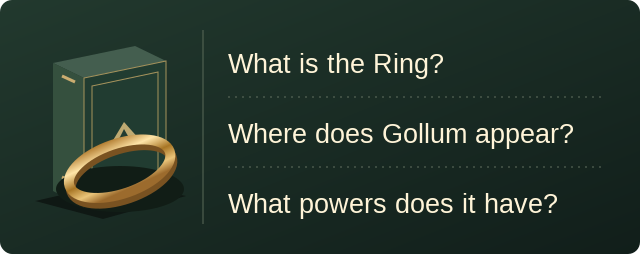
People got it straight away. Then I could take them back to the product. Suppose a salesperson and a new operator are looking at the same machine. One wants to show a customer what it can do. The other needs to know how to use it. We have one manual. Which passages would you choose for each Jig?
The question that came back
One question that came back was what knowledge the system was capturing. I’d started by showing what one person could generate. Now someone was asking what the platform would know the next time they used it. Afterwards, a backend engineer told me the presentation had captured what the team had been trying to explain. Our CTO thought the slides could be adapted for investors.
I like giving talks where people can bring what they already know to the discussion. A colleague in sales knows why a customer asks for a demo. Someone in training knows which detail a new operator might miss. Given the same manual, each could tell me something different about which passage belonged in the Jig.
I later gave a talk on retrieval and context engineering at the AI Ops Melbourne meetup. I wrote up the examples I used with that audience in What finally made RAG click for me.
What I still think about
That project changed the question I ask about AI products. If another SaaS team had access to the same model tomorrow, what would our product still know how to do better? My answer is in the work between the request and the result: finding the right source material, giving the model the context it needs, and checking whether the result is faithful to the source.
I’ve since found myself thinking a step further. If a manual mentions a part, a procedure and a safety warning, how do we know they belong together? A knowledge graph could record those relationships. An ontology could define what they mean across different manuals. What I remember most from the meeting, though, is the question about what knowledge we were capturing. I’d learned enough from the engineers to explain their concern, and someone else could now take the conversation somewhere I hadn’t planned.